
The biggest factors you can control are your visibility and defensive motorcycle riding habits. You’ll want to ride as though the drivers around you haven’t seen you, because in most multi-vehicle motorcycle crashes, they haven’t. Knowing how to prevent motorcycle accidents is especially important in New Hampshire because adult riders are not required to wear helmets.
The New Hampshire motorcycle accident lawyers at Shaheen & Gordon have represented injured riders for more than 40 years, and the same preventable patterns appear in case after case.
Why are motorcycle riders at such high risk?
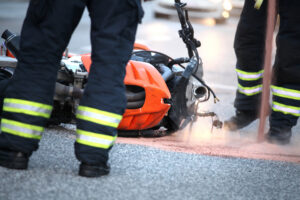
The risk often stems from surrounding protection, or lack thereof. On a bike, you have no steel frame or airbag between your body and the pavement, and you’re a narrow profile that drivers overlook. Motorcycle riders made up 16% of all U.S. traffic fatalities in 2024, with 6,228 killed, even though motorcycles are a small fraction of the vehicles on the road. Measured per mile traveled, a rider is almost 27 times more likely to die in a crash than someone in a car.
New Hampshire’s numbers follow the same line. The state’s Driving Toward Zero program counted 37 motorcycle operator deaths in 2023 and 31 more in 2024, heavy losses for a state of about 1.4 million people.
Does New Hampshire require you to wear a helmet?
In New Hampshire, only riders and passengers under 18 must wear protective headgear. New Hampshire leaves the choice entirely to adult riders, which few states do.
The numbers make a strong case for wearing one. In 2024, in states without a universal helmet law, 48% of the motorcyclists killed weren’t wearing one. In states that require helmets for every rider, it was 11%. Motorcycle helmets that meet the DOT’s FMVSS 218 standard carry a DOT symbol on the back of the shell – that’s the one to buy.
A helmet can’t keep a crash from happening, but it’s the best protection your brain has.
How can you increase your visibility to drivers?
One of the major causes of motorcycle accidents is lack of visibility. Ride with your headlight on at all times and use your high beam during the day. Drivers who hit motorcyclists will often tell police that they never saw the bike. You can increase your visibility with bright riding gear, reflective tape on the bike, a light-colored helmet, and lane positioning that keeps you out of the blind spot of the car ahead.
Don’t linger beside cars or trucks. If you can’t see a driver’s face in their side mirror, that driver likely can’t see you.
What does it mean to ride defensively?
To ride defensively is to assume you’re invisible and leave yourself an out. Keep a generous cushion of space around your bike. Cover your brakes at every intersection, because that’s where cars turn across your path. Follow the traffic laws you already know, including speed limits and lane markings; a rider moving faster than traffic expects is a rider that drivers misjudge.
Stay alert for the road hazards New Hampshire serves up in quantity, like frost heaves that can buckle pavement every spring, gravel on rural routes, and deer or moose at dusk. The Kancamagus Highway is a beautiful ride and a punishing place to carry too much speed into a blind curve. During Laconia Motorcycle Week each June, you can add heavy traffic and out-of-state drivers who aren’t used to sharing the road with thousands of bikes to the equation. Take precautions, be visible, and always stay alert.
You can’t avoid motorcycle accidents that other people cause, but you can reduce the risk of being in the wrong spot when a driver makes a mistake.
Should you take a motorcycle safety course?
Yes, even if you’ve ridden for decades. A motorcycle safety course builds hazard awareness and emergency braking skills that street miles alone don’t always teach. The licensing gap tells its own story: 35% of the operators in fatal U.S. crashes in 2024 didn’t hold a valid motorcycle license, according to NHTSA.
All states require a motorcycle endorsement to ride a motorcycle legally on public roads. New Hampshire’s rider education program offers approved courses statewide, and completing one can count toward earning that endorsement.
What protective gear should you wear?
Start with a good helmet, then cover everything else. Wear motorcycle-specific jackets and pants made from abrasion-resistant materials, which provide far better protection than ordinary clothing in a slide. Add over-the-ankle boots, gloves that improve your grip, eye protection if your helmet has no face shield, and reflective panels for riding after dark. Good protective gear earns its keep twice, as it shields you in a crash and keeps you comfortable enough to concentrate on long rides.
Related reading: What to do after a motorcycle accident
Talk to a New Hampshire motorcycle accident lawyer
Shaheen & Gordon has represented injured riders for decades, with 70+ attorneys and offices in Concord, Manchester, Nashua, Dover, Keene, Lebanon, and Peterborough. We handle personal injury cases on a contingency fee basis, which means you pay no attorney’s fees unless compensation is recovered.
If a crash has already happened, request a free consultation. Call (800) 451-1002 or contact us online, and we’ll talk through what happened and what your options are.